




Is It Normal to Still Look Pregnant After Birth?
Yes. Completely, absolutely, nobody-warned-you-and-they-should-have normal.
You've had the baby. And your belly still looks... like you haven't. If nobody warned you about this, you're not alone, it's one of the most common postpartum surprises for mamas, and one of the least talked about.
So let's talk about it. Here's exactly why it happens, how long it lasts, and what your body actually needs right now.
Why does your belly still look pregnant after birth?
A few things are happening at once, and understanding them makes the whole thing significantly less alarming.
Your uterus is still contracting back to size
During pregnancy, your uterus grows from roughly the size of a pear to the size of a watermelon. After birth, it doesn't snap back instantly — it takes six to eight weeks to fully contract back to its pre-pregnancy size through a process called involution.
In the first few days postpartum, you can often feel your uterus as a firm, rounded mass around your belly button. As the weeks pass, it gradually moves back down into your pelvis and reduces in size. The belly softens as it goes. If you're breastfeeding, the hormone oxytocin released during feeds helps speed this process along, which is also why feeding can sometimes bring on stronger cramping in those early days.
Your skin has been stretched for nine months
Your abdominal skin and muscles have spent the better part of a year accommodating a growing human. They don't spring back the moment that human arrives. Skin that has been stretched takes time to gradually adjust — and for many mamas, it never returns entirely to how it looked before. That's a completely reasonable outcome of growing a person.
Fluid retention and swelling
During pregnancy, your body holds significantly more fluid than usual. After birth, this fluid doesn't disappear overnight. In the first week or two, you may notice puffiness in your face, hands, feet, and abdomen. This is your body working to rebalance, and it will resolve naturally.
Abdominal muscle separation (diastasis recti)
Diastasis recti, the separation of the abdominal muscles down the midline, affects the majority of women to some degree by the third trimester. This separation contributes to a softer, rounder belly appearance postpartum, and it benefits from specific, gentle exercises during recovery rather than jumping straight back into intense core workouts.
If you notice a visible gap or ridge down the centre of your abdomen when you lift your head, mention it to your midwife or a women's health physio. Diastasis recti is common and very treatable — but the wrong exercises can make it worse.
How long does the postpartum belly last?
There's no single answer, because every body is different, and anyone who gives you a definitive timeline is probably selling something.
What most mamas experience:
First one to two weeks — the most significant change. Your uterus is contracting rapidly, fluid is reducing, and the belly visibly decreases.
Weeks two to six — continued gradual reduction. By six weeks, your uterus has returned to close to its original size.
Three to six months — skin and muscle tone continue to adjust, particularly if you're breastfeeding and gradually reintroducing movement.
Six to twelve months and beyond — many mamas find their body settles into its new normal around this time. Which may or may not look exactly like before — and both outcomes are completely valid.
The most important thing to know is that six weeks is not a finish line. It's a checkpoint. Real postpartum recovery — physically and hormonally — takes much longer than society tends to acknowledge.
What doesn't help
A quick note on what not to do, because the internet is full of bad advice on this topic.
Restrictive eating — your body needs significant nutrition to heal after birth, especially if you're breastfeeding. This is not the time to restrict calories.
Intense core workouts too soon — particularly crunches and sit-ups, which can worsen diastasis recti. Wait for clearance from a women's health physio before returning to core training.
Comparing your timeline to anyone else's — your body, your birth, your recovery. Someone else's six-week transformation on Instagram has nothing to do with you.
What actually helps
Rest. Actual rest. Your body heals when it rests. Every culture with strong postpartum traditions — and better maternal outcomes — prioritises rest in the weeks after birth. This isn't laziness. It's how recovery works.
Hydration and nourishment Drink more water than you think you need. Eat warm, nourishing whole foods. Your body is doing significant repair work and it needs the raw materials to do it well.
Gentle movement when you're ready Short walks, gentle stretching, and breathing exercises are appropriate in the early weeks. Build gradually from there, guided by how your body feels — not by a programme designed before anyone knew what your specific birth and recovery looked like.
Pelvic floor support A women's health physio or pelvic floor physiotherapist is worth seeing as early as six weeks postpartum to assess how things are healing and give you a personalised plan. This is the single most useful thing you can do for your postpartum body long-term — and in Aotearoa, your LMC can refer you.
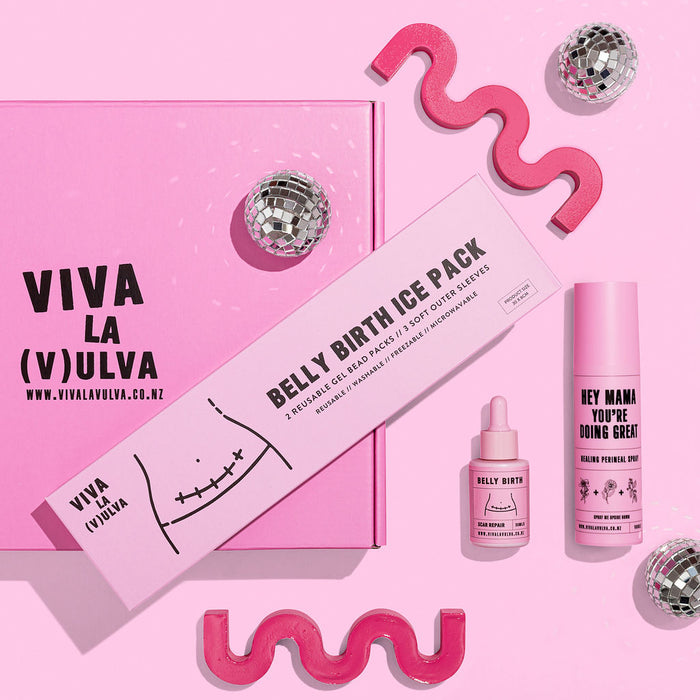
Support your perineal recovery If you had a vaginal birth, your perineal recovery directly affects how comfortable you feel in your body in those early weeks. The more supported your physical healing, the easier it is to rest, move, and recover overall. Our full postpartum recovery range is designed for exactly this.
The part nobody says out loud
The expectation that your body should look different — smaller, tighter, back to something — within days or weeks of giving birth is not based in biology. It's based in a culture that has consistently undervalued what women's bodies actually do.
Your belly grew a human. It made room, it stretched, it held, it worked. The shape it's in right now is the shape of something extraordinary.
You don't owe anyone a different body. You owe yourself a proper recovery.
When to talk to your midwife or LMC
Most of what we've described is completely normal. But a few signs are worth getting checked:
- Abdominal pain that isn't improving or is getting worse after the first week
- Swelling that seems extreme or is getting worse rather than better
- Fever alongside abdominal tenderness
- Feeling like something has prolapsed or isn't sitting right internally
If anything feels off — always check in. That's what your LMC and midwife are there for.
Frequently asked questions
How long does it take to not look pregnant after birth? For most mamas, the belly visibly softens over three to six months, with the uterus itself returning to close to its pre-pregnancy size around six to eight weeks. Full recovery — skin, muscle, shape — can take a year or longer. Both timelines are completely normal.
Why does my belly still look round weeks after birth? A combination of your uterus still contracting back to size, separated abdominal muscles (diastasis recti), fluid retention, and skin that needs time to adjust. All completely normal, all part of the process.
Does breastfeeding help your belly go down faster? It can — breastfeeding releases oxytocin which stimulates uterine contractions, helping it return to its pre-pregnancy size a little faster. But it's not significant enough to make breastfeeding a body-change strategy. Feed your baby in whatever way works for your family.
Is diastasis recti permanent? Not necessarily — many mamas see significant improvement with the right exercises and support, particularly working with a women's health physiotherapist. Some degree of separation can remain long-term, and that's okay. A physio assessment around six weeks postpartum is the best starting point.
Can I do anything in the first weeks to help my belly recover? Rest is the most important thing. Gentle walking once you feel ready. Avoid core exercise or heavy lifting until you've been assessed by your LMC and ideally a pelvic floor physio. Rushing this phase can create problems that take much longer to resolve.
Is it normal to still look pregnant at three months postpartum? Yes — completely. Skin, muscle tone, and body shape continue adjusting for months. If you had any degree of diastasis recti, that alone can make the belly appear rounder for longer. If you're concerned, a women's health physio assessment is always worthwhile.
Your body did something remarkable. It deserves time, nourishment, and a lot more patience than our culture tends to allow.
Not looking pregnant anymore isn't the goal. Healing is the goal. 💗
— The VLV Team
Read more on the Let's Talk Postpartum blog or explore our full postpartum recovery range.